24 January 2022

Pure Michigan Genealogy: Churches and Cemeteries

Pure Michigan Genealogy


There is no one source or repository for church records in Michigan.  Most church records are held by the church, their archives, or sometimes the parish minister or priest.  Occasionally, one will find church records in their local library, or a historical or genealogical society.  Once I found a list of the founders of a church in a local history, so don't forget to check those out.  Local histories are a good resource to find what churches were established at that time.  Check Google Books or Hathi Trust for local histories.  If you are really lucky you may find a published church history of your ancestors' church.

A Roman Catholic mission was in Sault Saint Marie in 1668.  St. Anne's was founded in 1701 in Detroit.  The first Protestant Church was Moravian, in Mount Clemens.  They were worshiping during the Revolutionary War. Congregationalists, Presbyterians, Episcopalians, Baptists, and Lutherans soon followed.  By 1865, the Methodist Church was the largest Protestant denomination in Michigan.

Church Record Sources
  1. Michigan Historical Collections, Bentley Historical Library, University of Michigan, Ann Arbor-a large collection of religious records are held here.
  2. Burton Historical Collection, Detroit Public Library, Detroit-many early Detroit church records.  Additionally, Catholic Mission Records, 1720-1772 are here.  A map of Detroit Catholic churches is available as well.
  3. Bentley Historical Library at the University of Michigan has vertical files finding aids for 48 Michigan religions.
  4. WPA's Michigan Historical Records Survey Inventory of the Church Archives of Michigan-a series of records published and available at Family Search and Bentley Historical Library.
  5. Western Michigan Genealogical Society Church Records Collection at the Grand Rapids Public Library.
  6. Family Search Michigan Church Records Wiki is a resource too.
Additional denomination specific resources are available for church record research:

Baptist
Church of Jesus Christ of Latter-day Saints 

Catholic
Congregational/United Church of Christ
Disciples of Christ
Seventh Day Adventist

Cemetery Resources
Pure Michigan Genealogy is a series of posts on researching in Michigan.  Churches and Cemeteries is part four in the series.  Other posts in this series include:


Pure Michigan Genealogy: Yankee Migration

Michigan Territory once had a reputation as "good for Indians and disease and not much else."  Men who served in the Michigan Territory during the War of 1812 sent word back home about the dismal area of the territory.  Surveyor General Edward Tiffin reported after an 1817 survey "no tillable acre in the whole territory, worthless soil, all they did find were bogs, swamps, mosquitoes, dangerous animals and savage Indians."

How Michigan Became a State

If this was the case how did Michigan ever become a state?  We have Lewis Cass, Territorial Governor and Henry Schoolcraft, explorer, to thank for new surveys showing that the territory was habitable.  Cass wrote to the general government saying that the lands of Michigan had been grossly misrepresented.  New surveys were ordered.  A sixty-five person team surveyed the area starting in May 1820, with Henry Schoolcraft in tow.  They found the wilderness very habitable.

How the Erie Canal Helped Michigan

Something else was happening during this time.  Robert Fulton discovered that steamboats could travel up the Hudson River from New York to Albany. Steamboat travel combined with the opening of the Erie Canal in 1825 allowed an all water route from the Atlantic Ocean to Michigan.  This allowed western migration to move from the Ohio Valley to the Great Lakes.

Michigan's First Survey

Lastly, John Farmer, an early surveyor from New York, sold a map and a gazetteer, "Farmer's Guide to Michigan".  The new survey results, the Erie Canal opening and Farmer's map and gazetteer reached those living in the east and new settlements were on the horizon.

Orlo Fenn Travels via Erie Canal

My ancestor, Orlo Fenn, was one of those who used the Erie Canal to travel to the Michigan Territory.  He writes back home to his family in Shoreham, Vermont:
We have enjoyed good health ever since we left Shoreham, for which we ought to feel thankful, but I must proceed to give you a short history of our travils (sic) since we left Shoreham. We arrived in Whitehall the same day we left Shoreham and locked up. The next morning we left and arrived in Troy on Friday morning. Left Troy Friday evening and arrived in Buffalo on Saturday of the next week in time to ship outboard the steamboat Ohio.  At 1/2 past 10 o'clock we left Buffalo for Detroit on Monday evening, which made us two weeks from home....
Source: ”A Letter to Shoreham,” Vermont Quarterly, July 1955, page 329.  From a letter written by Orlo H. Fenn, Dexter, Michigan Territory,  to his parents, Daniel Fenn and Huldah Rowley Fenn, in Shoreham, Vermont, 1 July 1832. 

Yankee Migration to Michigan

Orlo Fenn wasn't the only "Yankee" who migrated to Michigan during this time.  The population of the Michigan Territory in 1805 was about 4000, most of which lived in the Detroit, Frenchtown, Mackinaw and Detroit River vicinity.  By 1830 the population rose to 31630, many from the New England area.

This growth became known as the "Yankee migration."  What is a Yankee? Brian C. Wilson, author of Yankees in Michigan, defines it as a “distinct ethnic group...descendants of the first seventeenth-century English settlers to New England” 

The Yankee migration began around Plymouth, Massachusetts and continued to other points in Massachusetts.  Next, migration to Connecticut via the Connecticut Trail, then to Western Massachusetts, Vermont, and New Hampshire using the Connecticut River.  Many migrated to New York and Pennsylvania and the Northwest Territory.

Yankees left in hopes of finding better land. Lands in the east were being used up and if a family had too many sons, there wasn't enough land to inherit. Once land became available in the Northwest Territory many moved. First to Ohio, then Indiana and Illinois and eventually Michigan.

There was a song about this emigration, the Emigrant's Song:
Come all ye Yankee farmers who wish to change your lot,
Who’ve spunk enough to travel beyond your native spot,

And leave behind the village where Pa and Ma do stay,
Come follow me, and settle in Michigania-
Yea, Yea, Yea, in Michigania.

Population Growth in Early Michigan

The population steadily grew with this Yankee migration.  Michigan became a state in 1837. The 1840 population was 212,267; 1850 population was 397,654 with over 40% from six New England states:

  • Rhode Island-1031
  • Maine-1117
  • New Hampshire-2744
  • Connecticut-6751
  • Massachusetts-8167
  • Vermont-11113
  • New York-133756

Yankee Influence in Michigan

Michigan would be a different place without the Yankee influence. Yankees were involved in the law making and governing of Michigan.  The first fourteen governors were from the East . Michigan's First Constitutional Convention was 70% New Yorkers.  Michigan patterned many laws after New England states.  Punishments were taken from Vermont; Probate from Massachusetts; Real Estate laws from New York; and Townships from New England.  Just about every facet of Michigan growth can be contributed to the Yankee Migration, including education, religion, judiciary, business and more.

Today's Michiganders would never believe that Michigan was once described as inhabitable. Michigan is home to beautiful, sandy beaches, fresh water in rivers and streams, in addition to the four Great Lakes we border. It has fertile land and lush forests. The growth of Michigan from Yankee migration is one I am happy to call my own story.  I am glad my Fenn family traveled from Vermont and settled in my home state.  Yea! Yea! Yea! in Michigania.

Yankee Migration is one in a series of posts about researching Michigan.  The others are:


Pure Michigan Genealogy: Records

Pure Michigan Genealogy

A wide variety of Michigan records are available when researching your Michigan ancestor.  Some records are available online and others by doing onsite research.  Below is an overview of the common record sources for researching in Michigan.

1.  Census
     Many of you know about the federal population schedules, which Michigan is recorded in, but do you know that Michigan conducted its' own census collection?  One census collection that is valuable to Michigan researchers is the 1894 State Census.  The chart at Michigan Census Wiki details what census records are available for Michigan.  One as early as 1820.  The following free online resources will help you with the Michigan Census.
2.  Courts
The court system in Michigan is made up of 
  1. Municipal Court:  There are only four municipal courts in Michigan.  These courts have city jurisdiction and handle minor criminal, civil and small claims cases.
  2. District Court:  There are 107 district courts, many at the county level.  These courts handle misdemeanors and minor civil cases.
  3. Probate Court:  There are 78 probate courts.  These courts handle administration of wills, estates and trusts; treatment of mentally ill; and guardianship and conservators of minors, adults, and developmentally disadvantaged.  Michigan Probate Records, 1797-1973, are available to browse at Family Search.  
  4. Circuit Court:  There are 57 circuit courts that serve from one to four counties.  These courts are known as trial courts and handle felonies, major civil and domestic matters, and Naturalization until 1906.  Circuit court includes a family division which hears cases under the probate and juvenile code of Michigan.  The family division hears cases involving child abuse, name changes, adoption, emancipation of minors, divorce, custody, and personal protection orders.
  5. Court of Appeals:  This is an appelate court between the Circuit Court and the Supreme Court.     
  6. Supreme Court:  There is one Supreme Court in Michigan.  They hear cases that are appealed to it from the court of appeals.  They oversee all courts in Michigan.
An explanation of the Michigan Judicial System can be found here.  Very few court records are available prior to 1833, in Michigan.  Research with court records needs to be done with the clerk office in the appropriate court.  A trial court directory is available online.

3.  Naturalization
The naturalization records that are available are usually in the county clerk's office.  I would recommend calling the county clerk's office before researching onsite because some of the naturalization records have been transferred to the Archives of Michigan.  I found my great-grandfather's record from Marquette County at the Archives. The naturalization records held by the Archives of Michigan are being digitized and will be available at Michiganology when completed. A circular on Naturalization records is availabe that tells you what is available.

4.  Land
The earliest land records available for Michigan include those for Mackinac and Detroit private land claims, available at the National Archives.  Federal land patents are searchable at the Bureau of Land Management.  The first land office in Michigan opened in 1818, in Detroit.  The Archives of Michigan holds the original state land grant records.  Land records can be be also found at National Archives.  The register of deeds in each county is the repository for land sales and mortgages.  Family Search has a Land Record wiki for Michigan that is good.

5.  Military 
The Archives of Michigan is the repository for Michigan military records.  The archives guides list the military records available at the Archives.


 Other military records for Michigan include:
6.  Tax Records
Property tax records are kept at the county level.  There are 83 counties in Michigan.  The county treasurer or assessor or register of deeds office are in charge of these records in Michigan.  A complete list of Michigan Register of Deeds is available online.  

The Archives of Michigan has a circular on Tax Assessment Rolls which provides you with what rolls are available for each county.  You would have to visit the Archives to access these records.  There are some records available at regional archives in Michigan.  The list is provided in the circular too.

7.  Vital Records
The genealogy trifecta, birth, marriage, and death records are available in Michigan.  It is important to know the dates of vital record registration before researching.  Those dates are:
Vital Records are kept at the county level in the county clerk's office in Michigan.  I have found various times and days are available when researching at the clerk's office.  I recommend calling before you go, just to be sure.

Some vital records are available for order online.  The addresses and information can be found on the Center for Disease Control website. I would check with the Michigan county clerk first to see if the one you want is available. Birth records are not available for 100 years after the birth. Some restrictions apply to who can access these records.

The information provided for the record groups is not complete.  I tried to provide Michigan researchers information that is readily available.  I did not include any of the paid subscription sites which has Michigan record resources available for a fee.


Pure Michigan Genealogy is a series of posts on researching in Michigan.  Records is number four in the series.  The others are:

1.  Michigan History
2.  Migration and Immigration
3.  Records
4.  Yankee Migration
5.  Churches and Cemeteries
6. Archives, Libraries, Societies and Organizations
7.  What Else is There? 10 More Resources
8.  Maps 
9.  Living History

10. The End


Pure Michigan Genealogy-Migration and Immigration


Pure Michigan Genealogy


"If you seek a pleasant peninsula, look about you" is the Michigan state motto and I imagine my ancestors who immigrated from foreign lands coming to Michigan and seeing the beauty that I see when I look at my home state.  Clear blue lakes and rivers, rock structures and mountains, sandy beaches and dunes are what Michigan had to offer the first immigrants.

Before 1837, when Michigan became a state, Native Americans were the very first inhabitants.  Next, came the French, who were the earliest missionaries in the area. Then, the British arrived as a result of the expansion of the British Empire. Eventually, others realized what great opportunities Michigan offered.

Three rivers were important to the early settlement of Michigan.  The Clinton River Valley saw the settlement at Mt. Clemens, Pontiac, and Rochester.  Ann Arbor and Ypsilanti were formed along the Huron River.  Monroe, Tecumseh, and Adrian were settled along the Raisin River.  All three of these areas form a circle around Detroit.

The early Michigan pioneers migrated from New York and the New England area, settling in the Michigan Territory from 1830-1837.  Michigan became attractive to the early settlers because traveling to the territory became easier.  Originally, the only mode of transportation was by horseback or wagon train, which was a long and treacherous trip.  Steamship travel on Lake Erie became available, too.  The completion of the Erie Canal, in 1825, made migrating easier for New Englanders. Road construction from Ohio to Detroit and Chicago allowed settlers to arrive that way. Plus, land offices were opened in Monroe and Detroit.  These factors helped draw settlers to the territory.  140,000 pioneers came to the Michigan Territory from 1830-1837.  New York, Ohio, Vermont, Pennsylvania, and Massachusetts were the top five states early settlers migrated from.

Fertile land, forests, and mines were all available for early immigrants to develop.  Agriculture was the main economy.  Michigan's early history was rich in industrial development, much as it is today. Iron mining helped the manufacturing of stoves, steam engines and farm implements.  The Soo Locks and Railroads helped to grow Michigan's economy.  Copper mining was a draw as well as the lumber industry.  Later, automobile, chemical, and cereal manufacturing made Michigan a place to migrate to.

Foreign immigrants came from many countries to make Michigan a true melting pot. Michigan was made the state it is today from the many immigrants who traveled from their homeland during the years 1837-1924.

I will discuss the push (reasons for leaving their homeland) and the pull (reasons to immigrate to Michigan) factors by country.  The below countries are where the greatest number of immigrants came to Michigan.

1.  Canada
     Push
  • Political refugees from a 1837-1838 revolt.
  • Depression of the timber and shipbuilding industries
     Pull
  • Military, agricultural, economic, and industrial opportunities after the civil war
  • Michigan's close proximity to Canada provided a fresh start for some

Advertisement for M. H. Allardt, Michigan Commissioner of Emigration who was sent to Germany and set up an office in Hamburg.  Allardt published an eight-page magazine promoting Michigan to the Germans.

2.  Germany
     Push
  • Economic hardships, unemployment and crop failure
  • To avoid war and military service
  • German government encouraged the poor to emigrate

     Pull
  • Fertile farmland
  • State of Michigan recruited immigrants
  • Established German settlements (see note)
Note:  The first German immigrants came to Washtenaw County, in 1830, setting up missions.  Two early missions were in Ann Arbor, 1833, and Frankenmuth, 1845. These missionaries wrote back to Germany and encouraged others to immigrate.


The Cornish brought pasties (pass-tees) to the Upper Peninsula of Michigan.  
They were eaten by the miners and heated with a Cornish stove-
a candle under a shovel.

3.  England/Cornish
     Push
  • the dying copper mining industry in Cornwall, which is in southwest England.  Once a great copper mining area.
     Pull
  • copper and iron mines in the Keeweenaw Peninsula, in the Upper Peninsula, which today is known as "Copper Country"
4.  Ireland
     Push
  • Famine
     Pull
  • a place to start new
  • improvement of existence
The Irish in Michigan worked in mining and construction of railroads and canals.  They helped build the canal in Grand Rapids in 1835.  Some Irish were known as pack-peddlers.  Merchants from Northern Ireland traveled rural areas selling fine table and bed linens.  

5.  Netherlands
     Push
  • Religious upheaval in Netherlands
  • King William I tight control over the Reformed Church
  • Economic depression 
     Pull
  • Religious freedom
  • Improvement of existence
  • Economic opportunities in furniture industry, utilities and finance
6.  Finland, Sweden, Norway
     Push
  • Lack of suitable farmland
  • End of the guild system led to more urban centers
  • Change from rural to industrial system
  • Left to escape parental control, military service, political or religious persecution
     Pull
  • Availability of land
  • Economic opportunities with many Scandinavians working in the railroads, mining and furniture making.
7.  Poland
     Push
  • Failure of political revolts
  • Small land holdings
  • Low wages
  • High taxes
     Pull
  • Labor, including railroad workers, sewer and water main workers, and street pavers.  Later, for automobile and foundry.
8.  Hungary
     Push
  • Liberal revolts in 1848-1849
  • Peasants lack of economic success
  • Antisemitism led to immigration of Jews.
     Pull
  • Labor opportunities in mining; lumbering; and sugar beet producing in the Thumb area of Michigan.
9.  Italy
     Push
  • Few economic opportunities
     Pull
  • Manual labor and mining jobs 
During the Post World War II era, Michigan saw an influx from the African American population. They came from the Southern United States and were looking to improve their economic circumstances.  Many worked in the automobile and foundry factories.

Mexican immigration occurred around the same time.  Many Hispanic Americans worked in the farm industry.  Some were migrant workers and left for warmer climates in the winter months after all harvesting was done.

Michigan was hit hard during the manufacturing and economic crisis of a few years ago.  For awhile Michigan was losing population.  The past year or so, it has been more balanced, but not growing at this time.  Michigan is still reliant on manufacturing, but strides have been made in recent years to diversify the economy.  Recent efforts to diversify have led to jobs in the retail, government, medical and bio-tech sectors.

There were some common bonds among the immigrants no matter what country they emigrated from. Many immigrants wrote home encouraging others to join them in Michigan.  They came to Michigan looking for what we would now call the American Dream.  They wanted a job, a home and something better for their children.  

Sources:
DeBoer, Shirley, M, NGS Research in the States Series:  Michigan, Arlington, Virginia:  National Genealogical Society, 2008.

Eichholz, Alice, Editor, Red Book, Provo, Utah:  Ancestry, 2004.

Family Search Wiki, Michigan, [online resource],  Wiki https://www.familysearch.org/wiki/en/Michigan,_United_States_Genealogy
Accessed 24 January 2022.

Holick, Jennifer, Legacy QuickGuide Michigan Genealogy, Surprise, Arizona:  Millenia Corportation, 2013.

"Scandinavian  Immigration", Harvard University Library, Immigration to the United States, 1789-1930.  http://ocp.hul.harvard.edu/immigration/scandinavian.html:  Accessed 26 April 2013.

VanderHill,  Warren C.  Settling the Great Lakes Frontier:  Immigration To Michigan, 1837-1924.  Lansing, Michigan:  Michigan Historical Commission, 1970.

This post is the second post in a series of Pure Michigan Genealogy posts on researching your ancestors in Michigan.  To see the other posts, click on the post title below.


Pure Michigan Genealogy-Michigan History


Pure Michigan Genealogy

Some of you may have seen the Pure Michigan commercials enticing you to visit Michigan.  They even make me want to get out and explore my home state.  Pure Michigan is a tourism campaign to encourage people to come and enjoy all that Michigan has to offer.  If you haven't been to Michigan I invite you to come and enjoy our beautiful state.

I decided to borrow their slogan for my genealogy posts on my home state, Michigan.  I have been working, over the last few months, on a series of posts that will help those who have ancestors in Michigan with their research.  I have lived in Michigan for over 50 years and am fortunate that all eight of my great-grandparents settled here.  My roots run deep in Michigan.

Michigan has a deep heritage that starts before 1600. The state is rich in resources for genealogists. Please join me as we discover together my Pure Michigan Genealogy.

Michigan's early history starts with the Native American nations of Chippewa, Ottawa, Potawatami, Huron, Menominee, Miami, and a few others.  European settlers came to what is now Michigan and found about 15,000 Native Americans.  The timeline below shows the important events in Michigan History.

1622     Etienne Brule, a french explorer, is credited with being the first European explorer in Michigan.

1668     The first permanent settlement was established in Sault Sainte Marie by Father Pere Jacques Marquette.  Sault Ste Marie is the oldest community in Michigan.

1671     A Catholic mission was established at St. Ignace.

1691     Fort Saint Joseph (now Niles) was built.

1701     Antoine de la Mothe Cadillac and Alphonse de Tonty established a French settlement at Fort Pontchartrain (now Detroit).  Their wives settled there and are thought to be the first European women in Michigan.

1715     Fort Michilimackinac is built in what is now Mackinaw City, Michigan.


1718 Map

1756     The French and Indian War begins.

1760     Fort Pontchartrain is surrendered by the French to the British and ends French rule in Detroit. 

1787     Michigan becomes part of the Northwest Territory, except for Detroit and Mackinac which are under British control.

1796     British withdraws from all posts in Michigan.

1800     The area becomes part of the Indiana Territory.

1805 Map of Michigan

1805     The Michigan Territory is created by Congress.

1812     The War of 1812 begins and Michigan is in British control until 1813.

1818     The first land office is opened.  Steamships on the Great Lakes travel from Buffalo to Detroit.

1819     The Treaty of Saginaw gives millions of acres of Native American lands to settlers.

1825     Erie Canal to Buffalo is completed.

1832     The Chicago Road between Detroit and Chicago is completed.

1835     The Toledo War.  The settlement of this war gave Ohio the area known as the Toledo Strip and Michigan is granted what is now known as the Upper Peninsula.


1837     Michigan becomes the 26th state.

1840     Copper deposits found on Keweenaw Peninsula.

1847     Law passed relocating the state capitol to Lansing from Detroit.

1879     New State Capitol building is dedicated.

Michigan and its'83 Counties


1900     All of Michigan's 83 counties are settled.

1908     First car, the Model T, rolls off the assembly line in Detroit.

1929     Ambassodor Bridge from Detroit to Windsor, Ontario opens.

1930     Windsor Tunnel from Detroit to Windsor, Ontario opens.

1957     Mackinac Bridge opens connecting the lower and upper peninsula's of Michigan.


Michigan History is the first of ten posts about researching in Michigan.  The others are:

Preparing for a Visit to the Archives of Michigan

The Archives of Michigan is the repository of the governmental records of Michigan.  It houses records from state and local governments, public institutions, some organizations and some individuals.  Records date back to 1792. 

The holdings of the Archives include: 

  • 80 million state and local government and private papers
  • 300,000 photographs
  • 500,000 maps
  • Films
  • Audio tapes 
  • and more
 Many of the Archives holdings are being digitized at Michiganology. 

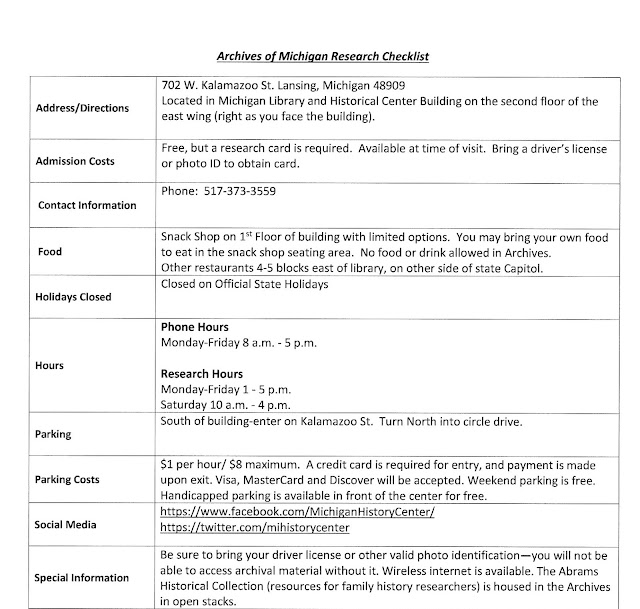
Anyone who plans to visit the Archives of Michigan will make better use of their time with some advanced planning.  This research checklist will give you the information you need for a visit.

Important things to remember:  1) Check the hours of operation and 2) Bring a photo ID or driver's license.  Researchers need a research card and you will need ID to get one.

The staff at the Archives of Michigan is awesome and available to help you, but if you want to make your research go smoother you will need to bring some information with you.  Knowing dates and places and how your research subject interacted with the government helps.  It helps if you know what specific records you would like to search.  If you are looking for land records, land descriptions help.  If you are looking for probate records, the date of death and county of death are needed.  If you are looking for Prison Records, the time period of incarceration is helpful.  The more information you can bring with you, the better your chance of success will be.

The Archives of Michigan offers guides and indexes to make your preparation easier.  The Guides do just that-guide you to archival material by subject matter.  The Genealogy Research Guide #64 explains what resources are available for family history researchers.  There are over 60 guides available to help you plan your trip.

The Archives of Michigan has one of a kind items.  For example, Guide #61-Diaries and Personal Journals has the list of what is in their holdings, subject and dates.  Your ancestor's diary may not be here, but someone else during the time period is and has written about the Civil War, Spanish American War, WWI, farming, etc.  They are fascinating reads.

Guide #3 is for those who have black sheep in their family!  The Correctional Records have prison registers back to 1839.  In addition to individual records, some with mug shots, the Archives has information on the Prison itself.  Maybe your ancestor received a Pardon, Guide 48 has Pardons, Paroles, Warrants and Extradition information.

Guide #22 Infirmaries, Sanatoria, and Poor Homes has institutional information.  Records that provide confidential information will need a copy of the person's death certificate to access.  County infirmaries and county poor home records do not have such restrictions.  If you are interested in this type of information, a call, or email, to the Archives may be best.

Lumbering, Logging and Forestry is an important part of Michigan History.  Guide #28 shows what is available in that subject.  Were your ancestors involved in mining? Guide #25 is the one you want.

A variety of school records are available at the Archives.  Check Guide #11 for what schools and dates are covered.

I have highlighted just a few of the over 60 guides available in .pdf format. Please contact the Archives of Michigan for more information.  

A little preparation will make your trip to the Archives successful.  Archives staff is available to help you from 8-5, Monday through Friday, via telephone at 517-373-3559 or email them at archives@michigan.gov  Onsite research hours are 1-5 Monday through Friday and Saturdays 10-4.

Read more about preparing for a trip at the Archives of Michigan website.

Updated 24 January 2021


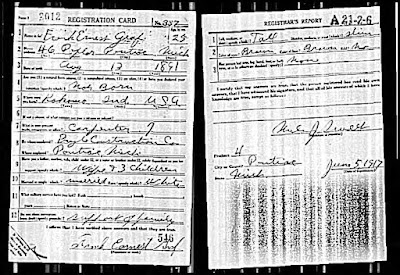
Frank Ernst Graf WWI Draft Registration


 Source: "World War I Draft Registration Cards, 1917-1918," [database on-line], Ancestry.com (www.ancestry.com : accessed 25 June 2021), Entry for Frank Ernest Graf Number 337; United States, Selective Service System. World War I Selective Service System Draft Registration Cards, 1917-1918. Washington, D.C.: National Archives and Records Administration. M1509, 4,582 rolls. Imaged from Family History Library microfilm.

My great uncle, Frank Ernest Graf, was 25 years old when he filled out his World War I draft registration. Frank was the son of Valentine Graf and Nancy Mast. The information on his draft registration was substantiated by my research, with one exception, the number of children.


He was born 13 August 1891 in Kokomo, Howard, Indiana, United States. He was one of seven children who lived to adulthood. The family left Indiana and moved to Brethren Michigan around 1900.


In 1917, his occupation was a Carpenter in Pontiac, Michigan. He had a wife and three children at this time. If he signed the draft registration 5 June 1917, he had four children: Beulah, Garl, Richard, and Donald. Donald was born 2 May 1917. He may have forgotten about his six-week-old baby.


Frank Ernest Graf wasn’t drafted.

23 January 2022

The Michigan Death Certificates, 1921-1946 Are Now Available

Downloaded version of Michigan Death Certificates, 1921-1946 for August Fredrick, my great grandfather.  Found at michiganology.org

The Archives of Michigan has been working on getting the Michigan Death Certificates, 1921-1946 added and searchable to their Michiganology.  2022 was the first year that the back end of the website did what it was supposed to do-add the new year automatically.

Currently, the death certificates cover the years 1921-1946.  Each January another year will be added until all, up to 1952, death certificates are online.  An index through 1952 is available. Those 1947-1952 death certificates are accessible at the county clerks office.

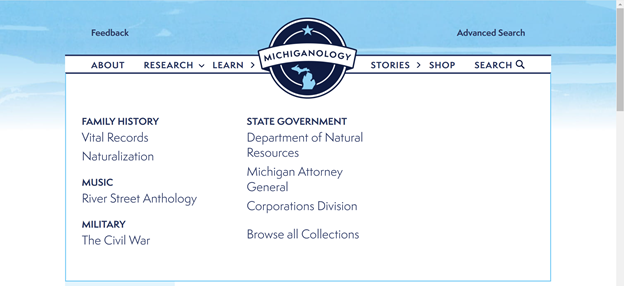
To access the records: Go to Michiganology>Research>Vital Records.

I appreciate being able to access these images of the death certificates. The best part is that they are FREE! 

If you have ancestors who died in Michigan, check the death certificates at Michiganology. 


This post was updated on 22 January 2022 editing information that was previously at Seeking Michigan.