07 March 2022

The Gift of an Autobiography-Fort McClellan, Alabama

The post I wrote about military newspapers, Using Military Newspapers in Your Research, got me thinking about my father's time at Fort McClellan, Alabama. My dad wrote about his time at Fort McClellan in his autobiography.

THE POST WAR YEARS 1945-46

     "The most beautiful sight I think I ever witnessed up to this time of my life occurred on the voyage home when our ship entered New York Harbor and for the first time I saw the “Statue of Liberty.”  What excitement to finally be coming home to see Mom, Dad, and all my friends. I was given a two-week furlough before an assignment at Fort McClellan, Alabama as a physical Training and Bayonet Instructor. We all figured it would only be a matter of time before we would be heading to the Pacific Theater. I did not have enough points to get out yet. While at Fort McClellan I also coached and played on a company basketball team in the evening for recreation. We didn’t have a very good team. At the end of the season there was a post championship tournament in which the seven regiments stationed there selected all-star teams from their regiments. Colonel Reeder, the Regimental Commander of the 7th Regiment, of which I was a member, asked me to coach the team which I gladly accepted. We had two weeks to practice, pick our team and get ready for the Tournament.

      The 3rd Regiment won practically every year and were heavy favorites as they had some college players, including one who played some at Notre Dame. I was discouraged when I held our first couple of tryouts as there seemed to be hardly any talent at all. Then one night I heard a knock on my door in the Officer’s quarters and a Captain from another company in our Regiment said he just got a shipment of new trainees fresh out of New York high schools and they wanted to play basketball and was there any openings. I would have accepted anyone at this time and told them to report to the gym the next night at 7 o’clock. Five boys reported and all of them had either played together or against each other in New York City schools.

     WOW ONE TRIP UP AND DOWN THE FLOOR AND I HAD MY STARTING FIVE. Jack Gilcrest was a 5-10 guard who could shoot the eyes out of the basket. An Italian lad named Pommerano was 6-2 had all the moves in the middle, shooting, passing, and rebounding. The other three boys were equally impressive, and they blended as a team as if they had played together all their lives. To make a long story short we won the tournament breezing handily through the first two games and whipping the 3rd Regiment in the finals by two points. I, along with the team, was the Toast of the Regiment as a result. My biggest contribution was probably staying out of the way and letting them play. I honestly believe this experience was a catalyst for launching my coaching and teaching career at Western Michigan University in Kalamazoo, following my release from the service.

     While at Fort McClellan the War in the Pacific ended in August 1945 with the surrender of the Japanese forces. I was honorably discharged at Camp McCoy north of Wisconsin on May 2, 1946, after 33 plus months of service. I left the service with the Expert Infantryman’s Badge, a Combat Infantryman’s Badge, and a World War II Victory Medal."


I wanted to find out more about the tournament he coached and since I am not able to go to Fort McClellan at this time, I thought I would see if there was a Facebook page for Fort McClellan. I found one, Fort McClellan Memories. I posted the paragraphs from my dad's autobiography and pictures of the tournament asking if anyone knew of any newspaper archives available. I did get a couple of interesting comments. One was from someone who had worked at Fort McClellan and said the gym was Miller Gym. Another thought the records were archived at Fort Leonard Wood in Missouri. This led me to more ideas for research. I will share my findings as I get replies from a few written inquiries.


My dad's autobiography has been a gift that keeps on giving. I am happy he wrote and published it. He gifted it to every family member. Since his death, in 2018, I have been asked by his former athletes and students if they could get a copy. I have shared it with those who ask. 

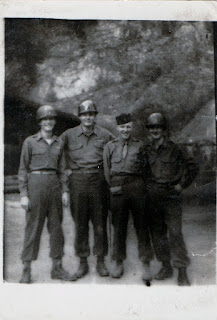
 Picture Information: The picture is one that was in my dad's collection. Bruce Glover is the last one on the right. I do not know who was in the picture with him and my father didn't remember their names.


04 March 2022

Are You Using These Genealogical Sources?

Are you satisfied with low hanging fruit genealogical sources, or do you strive to dig deeper with your ancestry? Most genealogists will tell you to start your research with the census. The census is readily available online and easy to use. Other easy sources to find are death and marriage records. I consider these low hanging fruit sources, ones that are easy to find.

Digging deeper or using records that are tougher to use and harder to find are important when doing genealogy research. I used to think if I could fill a five-generation pedigree chart with names, birth, marriage, and death data I would be happy. The more I research the more I want to know. I am not satisfied with 'just the facts'.

Some records aren't used as often as they should. How many of the records below do you use regularly in your research?

Genealogical Records to Pursue

Land Records-you either love them or hate them. Usually, land records are easy to find. They are recorded at the county or state level and have been archived. Family Search and Ancestry have numerous land records in their databases. I will admit I like the information I find in land records, but do not enjoy reading them. Reading them on microfilm is even more challenging. Once I read so many land records on microfilm, I think I got motion sickness.

Land records are important because they show where your ancestor purchased or sold land. Remember they may not have lived on that land. They can show family relationships. Finding, using, and understanding land records provides valuable information.

A tip I received from Rhonda McClure at the New England Historic Genealogical Society was to add all the land bought and sold. If the numbers aren't equal, there is more to find.

Voter or Poll Records-qualifying to vote can provide records of interest to genealogists. Potential voters must prove residency. I have seen addresses, ages, previous voting place, and naturalization information in these records. Voting records are held at the city, town, or township level.

Criminal Records-do you have an outcast in the family? Look in newspapers and court records for more information. Information gleaned from these records can lead one to other records of importance.

Probate Records-Probate records are coming online more these days. I know Calhoun county, Michigan has microfilmed their probate records and the index is available online at Willard Library, Battle Creek, MI. The Archives of Michigan is in the process of scanning all the probate records in their possession and will be available at Michiganology when completed.

Tax Records-Benjamin Franklin says nothing is certain except death and taxes. Tax records are the first ones to be re-recorded in the case of a fire or damage. The government wants their money, and the taxpayer doesn't want to pay twice. The taxpayer will bring receipt of tax payment to the assessor. Information varies on what is recorded, but they are well worth finding.

Manuscripts-genealogists underutilize manuscripts because they are harder to find, or one doesn't know where to look. Finding aids are important when looking for manuscript material.

  • World Cat-provides the researcher with access to over 10,000 libraries and archives. Information varies, but look for a diary, oral history, church membership, and other records. I found church records for Ypsilanti Presbyterian Church by using World Cat. They are stored at Bentley Historical Library at University of Michigan. 
  • NUCMC-National Union Catalog of Manuscript Collections leads the researcher to archival and manuscript materials. Once you learn how to search at NUCMC a world of resources is open. Repositories include historical societies. Family letters, bible records, plantation owners, tax lists, marriage records, and more can lead you to your family.
  • Archive Grid-is a great resource for unpublished resources. Finding a diary, school record, or store ledger is a genealogical gem for those looking for them. The difference between Archive Grid and World Cat is that Archive Grid is for unpublished resources and World Cat covers published resources.

Most manuscript collections are not digitized, but the catalogs listed above will lead you to the repository. Next, you will need to plan a road trip or contact the repository for access information. 

If you haven't explored manuscripts, please do, you won't be disappointed. I have found items I had no clue existed by being creative in my search. A few examples of my searching included: Manistee Lutheran minister, Lemke; lighthouse keepers in Michigan; Ypsilanti MI Presbyterian church records, justice of peace records for Detroit, Michigan, Governor Begole records, and so many more.


02 March 2022

My March Ancestors


and


The first of the month is a good time to share anniversaries of births and marriages from my family tree. Below is the list of people and their anniversaries. No living people are included in my list.

1 March 1699/1700

Joseph FULLER (322)

2 March 1742

Ambrose SALISBURY (280)

2 March 1763

Christina LIVENGOOD (259)

2 March 1800

Mary KINGSLEY (222)

3 March 1636

Uli MAST (386)

3 March 1693

Hans MAST and Anna MISHLER (329)

3 March 1742

Anna Margaretha GERMANN (280)

3 March 1837

Henry Pierce Strong GLOVER (185)

4 March 1671

Mehitabel OSGOOD (351)

4 March 1772

Elihu ROWLEY (250)

4 March 1787

Mary SCHROCK (235)

4 March 1846

Daniel C. FENN and Jane E. POOR (176)

4 March 1871

Julius ZOBEL (151)

4 March 1886

Jean Ethel WATT (136)

6 March 1789

Alexander GLOVER (233)

6 March 1805

Anna Caroline KONIG (217)

6 March 1838

Adaline L. DYER (184)

7 March 1796

Charles Williamson GLOVER (226)

7 March 1865

Samuel MAST (157)

8 March 1646

John HASELTINE and Joan ANTER (376)

8 March 1941

Carl Edward MCDONALD and Betty Leona BOND (81)

9 March 1727

Jonathan ROWLEY and Anne FULLER (295)

9 March 1891

Laura Myrtle MCGEE (131)

9 March 1893

Edna May MCGEE (129)

9 March 1935

Raymond Paul GRAF and Virginia MILLER (87)

10 March 1743

Moses POOR (279)

10 March 1766

John "Hans" SCHROCK (256)

10 March 1845

Frank Cushman BEGOLE (177)

11 March 1817

Fredrick BEGOLE (205)

11 March 1861

Gustav Ernst RADKE (161)

11 March 1883

Annie Eliza "Mabel" MCGEE (139)

11 March 1889

Laura Myrtle MCGEE (133)

11 March 1917

Francis Mae GRAF (105)

13 March 1915

Margaret Ruth CHALMERS (107)

14 March 1689/90

Jonathan CLARK (332)

14 March 1699/1700

Joseph POOR (322)

17 March 1779

John LIVENGOOD (243)

17 March 1844

Harriet M. A. "Annette" GLOVER (178)

18 March 1789

Huldah ROWLEY (233)

19 March 1843

George DYER (179)

20 March 1653

Mary ROWLEY (369)

20 March 1756

Alexander GLOVER (266)

20 March 1867

Silas R. FENN and Elizabeth BUSH (155)

20 March 1906

Lenore BRUCE (116)

21 March 1618

John MAYO and Tamisen BRIKE (404)

21 March 1796

Mary "Maria" MAUST (226)

22 March 1916

William Arthur FREDRICK and Grace L. FILLACY (106)

23 March 1739

Hannah SANTCLARE (283)

23 March 1767

Johann Friedrich GRAF (255)

23 March 1797

Peter BEACHY (225)

23 March 1884

Mary H. FREDRICK (138)

24 March 1774

John MOTT and Mary ROWLEY (248)

24 March 1818

William Powers GLOVER (204)

24 March 1841

Jesse YOUNGS (181)

24 March 1881

Margaret "Maggie" MCGEE (141)

24 March 1888

Hibernia Sarah "Bernice" MCGEE (134)

24 March 1899

William Wilfred MCGEE (123)

25 March 1696

John WEST and Mary WEBSTER (326)

25 March 1787

Christian L. LIVENGOOD and Elizabeth FORNEY (235)

25 March 1792

Joshua BEGOLE (230)

26 March 1698

Mary POOR (324)

26 March 1906

Catherine Louise CHALMERS (116)

26 March 1921

Mabel Louise RUFF (101)

27 March 1700

Elizabeth GLOVER (322)

27 March 1867

Georg GRAF and Lena HANKS-GAHS (155)

27 March 1922

Murriel Elaine GYOLAS (100)

27 March 1948

Michael Fay FREDRICK (74)

29 March 1769

Elizabeth FORNEY (253)

31 March 1696

Henry GLOVER and Mary CREHORE (326)

31 March 1767

Moses POOR and Hannah SANTCLARE (255)

31 March 1837

Henry Pierce Strong GLOVER (185)

1 April 1635

Governor Thomas PRENCE and Mary COLLIER (387)


01 March 2022

12 Years of Blogging


Happy Anniversary to me or should I say to my Journey to the Past blog. Thank you to all my readers for sticking with me the past twelve years.

Twelve years ago, today, I decided I wanted to share my family history via a blog. I started out doing very well and even won an award or two, but then as often happens life gets in the way and my blogging suffered. Hopefully, I am back to regular blogging.

I looked at my top ten posts and find it interesting that in the number one spot is my ancestor biography of Daniel C. Fenn. If you are viewing this as a relative of Daniel, please email me. I would love to make new cousin connections.

I am happy to see people are looking at my Pure Michigan Genealogy posts. I updated all ten of the posts in January, 2022. I like to use my blog to promote Michigan records and repositories.

The only surprise is number 7, Do You Have Summer Genealogy Plans? I didn't share anything newsworthy. I just shared five goals I had hoped to accomplish.

These are the top ten all time viewed posts.

  1. Ancestor Biography: Daniel C. Fenn
  2. Historic Adventist Village, Battle Creek, MI
  3. Pure Michigan Genealogy: Records
  4. Michigan's Role in the War of 1812
  5. Ancestor Biography: Otto August Fredrick
  6. Tech Tuesday: Social Media for Genealogy Analysis
  7. Do You Have Summer Genealogy Plans?
  8. Was Your German Ancestor Recruited to Come to Michigan?
  9. Surname Saturday: Livengood
  10. Pure Michigan Genealogy: Migration and Immigration


27 February 2022

Obituary of John Zobel

I have John Zobel to thank for helping me discover more about my Fredrich family. It was the 1862 marriage of Johan Zobel and Henriette Fredrich, that I found on Poznan Project, that provided me with the name of her father, Christoph Fredrich. Henriette Fredrich is the sister of my great grandfather, Johan August Fredrick (h).

Johan John Zobel was born 23 November 1834 and died 31 October 1921. His obituary was found on the front page of the Manistee Daily Advocate.


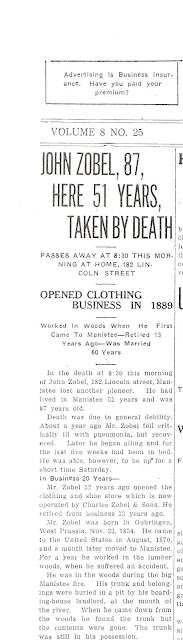
Transcription: JOHN ZOBEL, 87, HERE 51 YEARS, TAKEN BY DEATH

PASSES AWAY AT 8:30 THIS MORNING AT HOME, 182 LINCOLN STREET

OPENED CLOTHING BUSINESS IN 1889

WORKED IN WOODS WHEN HE FIRST CAME TO MANISTEE-RETIRED 13 YEARS AGO-WAS MARRIED 60 YEARS

In the death at 8:30 this morning of John Zobel, 182 Lincoln St., Manistee lost another pioneer. He had lived in Manistee 51 years and was 87 years old.

Death was due to general debility. About a year ago Mr. Zobel fell critically ill with pneumonia, but recovered. Later he began ailing and for the last five weeks had been in bed. He was able, however to be up for a short time Saturday.

In business 20 years 

Mr. Zobel 32 years ago opened the clothing and shoe store which is now operated by Charles Zobel & Sons. He retired from business 13 years ago.

Mr. Zobel was born in Guhringen, West Prussia, Nov. 23, 1834. He came to the United States in August, 1870, and a month later moved to Manistee. For a year he worked in the lumber woods, when he suffered an accident.

He was in the woods during the big Manistee fire. His trunk and belongings were buried in a pit by his boarding house landlord, at the mouth of the river. When he came down from the woods he found the trunk but the contents were gone. The trunk was still in his possession.

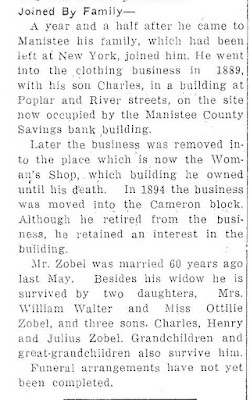
                                            Joined by family 

A year and a half after he came to Manistee his family which had been left at New York, joined him. He went into the clothing business in 1889, with his son Charles, in a building at Poplar and River streets, on the site now occupied by the Manistee County Savings Bank building.

Later the business was removed into the place which is now the Woman's Shop, which building he owned until his death. In 1894 the business was moved into the Cameron block. Although he retired from the business, he retained an interest in the building.

Mr. Zobel was married 60 years ago last May. Besides his widow he is survived by two daughters, Mrs. William Walter and Miss Ottilie Zobel, and three sons, Charles, Henry and Julius Zobel. Grandchildren and great-grandchildren also survive him.

Funeral arrangements have not yet been completed.


Source: Manistee News Advocate-Manistee Daily Advocate, 31 October 1921, Front page, column one, newspaper owned by Manistee County Historical Museum, Manistee, MI. 

25 February 2022

Canadian Attestation Record of Victor Tyson

Source: "Canada, Soldiers of the First World War, 1914-1918," database, Ancestry.com (www.ancestry.com : accessed 23 June 2014), entry for Victor Tyson; Number 2378593; Original data: Canada. "Soldiers of the First World War (1914-1918)." Record Group 150, Accession 1992-93/166, Box 4930 - 35. Library and Archives Canada, Ottawa. Now at ancestry.com under Canada, World War I CEF Attestation Papers, 1914-1918. 

My great aunt, Adeline Glover, married Victor Tyson one hundred years ago, on 25 Feb 1922, in Marquette, Michigan.

Victor was born in Gosforth, England. During the First World War he served overseas with the 44th Canadian machine gun battalion and was wounded in action.

I found Victor's attestation record where he agrees to serve the Canadian Over-seas Expeditionary Force, at Ancestry. He was living in Superior, Wisconsin and his paper was stamped U.S. Recruit.

These attestation papers provide a lot of information about Victor. Birth date, birthplace, residence, occupation, and father's name are listed. If you have United States ancestors it is worth your time to check the World War I CEF Attestation Papers for your ancestor, especially if they live in a state that borders the United States. 


21 February 2022

World War I Draft Registration of William Tritten


 Source: "World War I Draft Registration Cards, 1917-1918," [database on-line], Ancestry.com (www.ancestry.com : accessed 2 November 2014), entry for William August Tritten; United States, Selective Service System. World War I Selective Service System Draft Registration Cards, 1917-1918. Washington, D.C.: National Archives and Records Administration. M1509, 4,582 rolls. Imaged from Family History Library microfilm.


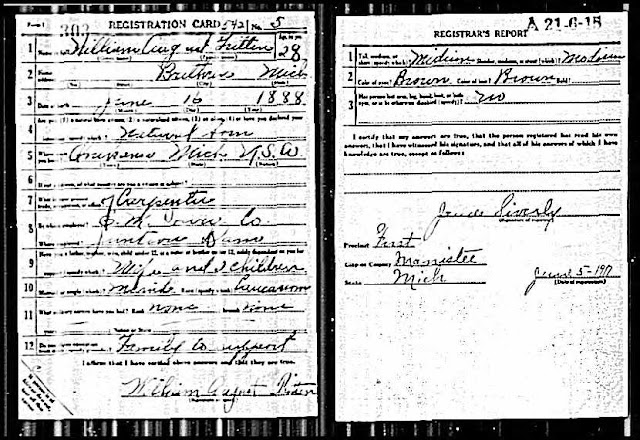
My great aunt, Mary Graf Tritten, married William August Tritten in 1913. William registered for the World War I draft registration in 1917 and listed wife and children as the reason for not serving.

The above draft registration shows William was born 16 June 1888, in Onekama, Michigan or at least I think that is what it says. What do you think?

He was employed as a carpenter with E. M. Power Co. at Junction Dam, which is now Tippy Dam. 

William and Mary Tritten had eight children: Ruby, Evelyn, Fred, Lloyd, Helen, Lester, Verna, and Jack.

18 February 2022

Book Review: Michigan Genealogy Sources & Resources by Carol McGinnis

Anyone who has roots in Michigan should have a copy of Carol McGinnis's "Michigan Genealogy Sources and Resources." I have had the second edition of Carol's book for quite a few years now. 

McGinnis's book is a fine example of a professionally written state specific guidebook. Although dated, a copyright of 2005, it still has information relevant to Michigan genealogists today. Chapters one and two provides the reader with historical information. Chapter one covers Michigan History. Chapter two covers why settlers came to Michigan.

Chapter One, "the earthly paradise" begins pre-statehood with the early exploration of the state by the French. The history continues with the changes after the French and Indian War. The history of Michigan during the Northwest Territory days up to statehood is included. This chapter provides a concise history of the early days of what is now Michigan. A historical highlights timeline is included at the end of the chapter.

Chapter Two, 'The Settlement of Michigan" tells the tale of how and why people settled in Michigan. Factors influencing settlement starts with the fur trade, the opening of the Erie Canal, and the emergence of new industry for lumber, copper and iron ore mining.

McGinnis tells of recruitment efforts and the establishment of an official emigrant agency which sought to encourage emigration from European areas, especially Germany.

Other pull factors such as religion, lumbering, mining, and manufacturing are written about in detail. Records that give clues about immigration and migration completes the chapter.

I know you are thinking a book that is seventeen years old can't be of value when there is so much on the internet today. I disagree. Michigan Genealogy is a well-researched, well written book on Michigan genealogy resources. I have turned to it a number of times in my research and writing.

The next four chapters, three through six, covers the records themselves. Chapters on vital records, alternative sources for vital records, census records and their substitutes, and land and court records are written specifically for Michigan researchers. Text and charts are included in these chapters.

Chapter Seven, "Digging Deeper", gives the reader an idea of what other types of Michigan records are available and where to look for them. These include manuscript collections, business records, institutional records, criminal records, coroners' files, orphans and orphanages, organizational records, territorial records, depression era records, disasters, life in Michigan and records in Canada. Each section of this chapter tells what is available for Michigan.

Michigan has a rich cultural heritage. From the Native Americans to the French to African Americans to European and Middle Eastern settlers, Michigan is one of the most diverse states. Chapter Eight, "The People of Michigan" shows the diversity that is within our state. Ethnic group's resources are included.

Chapter Nine, "Michigan Online", is the one chapter that would need to check the resources on your own. Using a search engine of your choice makes it easy. Many of the URLs have changed but inputting the title of the resource into a search engine will provide you with the current website. 

"Counties and Their Records" is the subject of chapter ten. Michigan has eighty-three counties, and each county has historical and contact information included. The contact information should be verified before using it.

The chapters conclude with genealogical collections and historical and genealogical societies. The collections available in the libraries, archives, and county repositories completes the resources available for Michigan research.

The book concludes with notes, sources, and an index. Overall, the book is an excellent resource. I have seen McGinnis's book on many genealogy syllabi when it comes to Michigan research topics.

The wealth of information in "Michigan Genealogy Sources & Resources" will get you started with your Michigan research and be helpful the further you dig for your Michigan Roots.

If you would like to purchase a copy of Michigan Genealogy, go to Michigan Genealogy at genealogical.com and use coupon code mcmi for 20% off the hard copy or .pdf copy. The coupon code is good through March 7th.

Disclaimer: I was not compensated in any form for writing this review. I purchased my own book many years ago. I was asked by Joe, Marketing Director at Genealogical.com if I would be interested in writing a review on my blog and I said, yes!