01 February 2022

My February Ancestors


Using the Birthday and Anniversary list feature in Roots Magic, I made a report of the people in my database to celebrate in February. There are no living people included in this list. 


and

Images courtesy of Pixabay

1 February 1763

Johann Philipp GRAF and Maria Catharina GEFFINGER (259)

1 February 1780

Alexander GLOVER and Sarah SALISBURY (242)

1 February 1910

Charles Leo GRAF (112)

2 February 1746/7

David POWERS (275)

3 February 1909

Carl Henry TRITTEN (113)

4 February 1742

Jonathan ROWLEY and Esther  (280)

5 February 1809

Orlo H. FENN (213)

7 February 1920

Lola Mae FREDRICK (102)

8 February 1734

Stephen SALISBURY (288)

8 February 1814

William G. DYER (208)

8 February 1833

Samuel POOR (189)

8 February 1880

Augusta "Gustie" FREDRICK (142)

8 February 1948

Charles J. BOSSERD and Sally Anne FENN (74)

9 February 1689

Daniel POOR (333)

10 February 1651/2

Thanks SHEPARD (371)

10 February 1743

Thomas GLOVER and Joan SWIFT (279)

12 February 1861

Jesse Edward YOUNGS (161)

12 February 1895

Dora Frances NELSON (127)

13 February 1649/50

Nathaniel MAYO and Hannah PRENCE (372)

13 February 1649

John FREEMAN and Mercy PRENCE (373)

16 February 1665

Ruth POOR (357)

17 February 1898

Adeline Elizabeth GLOVER (124)

17 February 1925

Bruce David GLOVER (97)

18 February 1828

Eve MAUST (194)

20 February 1741

Enoch POOR (281)

20 February 1830

Philippina Elisabetha GRAF (192)

20 February 1942

Thomas Edward HOOK (80)

21 February 1680/81

Sarah MERRIAM (342)

21 February 1918

Walter Fredrick BROWN (104)

22 February 1832

Orlo H. FENN and Lois Turrill LAWRENCE (190)

22 February 1896

Carlyle E. MCDONALD (126)

23 February 1586

Stephen TRACY and Agnes Anne ERDLEY (436)

23 February 1619

William PLASSE and Phebe MANNING (403)

23 February 1735

Elizabeth BEAL (287)

23 February 1871

Nancy D. MAST (151)

24 February 1716/7

Mary TRYON (305)

24 February 1853

Caroline GRAF (169)

25 February 1797

Daniel POOR (225)

25 February 1877

James MCGEE (145)

25 February 1922

Victor TYSON and Adeline Elizabeth GLOVER (100)

26 February 1785

Anna Maria GRAF (237)

26 February 1859

Tully Daniel FENN (163)

27 February 1875

Walter Stillman GLOVER (147)

28 February 1794

Eleanor Price BOWLES (228)

28 February 1808

Daniel FENN and Huldah ROWLEY (214)

28 February 1820

Orpha Ann FENN (202)

28 February 1835

Oscar E. FENN (187)

28 February 1893

Alma FREDRICK (129)

28 February 1905

Henry GRAF and Mary Agnes BOWLAND (117)

29 February 1828

George Begole POOR (194)


31 January 2022

Using Military Newspapers in Your Research

Newspapers are an excellent source for finding family history. One type of newspaper that you may not have thought of using is military newspapers. If one of your ancestors were stationed at a United States camp or fort, it might be worth your while to see if there was a newspaper published during the time your ancestor spent there. 

Source: Fort Custer News, Volume Three Number 33,Front Page, 17 September 1943. Found at Fort Custer Historical Society Library, Battle Creek, Calhoun, Michigan

Fort Custer in Battle Creek, Calhoun, Michigan had a newspaper called, "Fort Custer News" A search at the Library of Congress for Fort Custer News provides information on the publication. The starting date is unknown. The earliest ones I have found at Fort Custer Historical Society Library is 1942.


The newspaper was edited and published by the personnel at Fort Custer.  The information provided in the newspapers states, "Published every Friday for officers and enlisted men of Fort Custer, Michigan, under the direction of the Post Special Service Office, and edited by personnel of this post. The Fort Custer News receives material supplied by Camp Newspaper Service, War Department, 205 East 42nd St., N.Y.C. Such credited material may not be republished without permission from Camp Newspaper Service. However, uncredited material herein contained is available for general release and reprint in other publications without further permission."


A staff of five was listed:

  • Major Earl B. Barkley   Editor
  • Sgt. George Wm. Averill   Managing Editor
  • Pfc. Pat Richards  Sports Editor
  • Pvt. Jay Russell   Feature Editor
  • T/5 Myrl Simoneaux   Signal Corps Photographer 

The 17 September 1943 issue was eight pages long. The types of articles in this edition included Fort Custer news, weddings, lists of men/women leaving for overseas from Fort Custer, nurse assignments to Fort Custer, ration reminders, soldier of the week, church services, list of places and where to find them on the Fort, service club activities, movie guide for Fort Custer's three theaters, regiment information, WAC activities, comics, and a sports page.


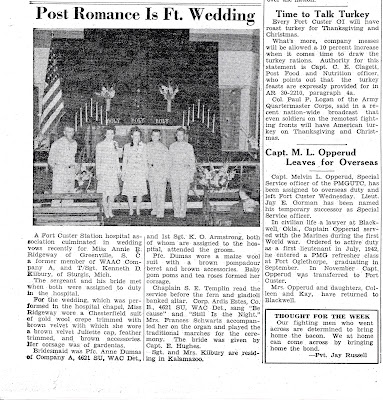
Source: Fort Custer News, Volume Three Number 3317 September 1943. page 2, first, second, and third column. Found at Fort Custer Historical Society Library, Battle Creek, Calhoun, Michigan

The majority of the news published had information pertinent to Fort Custer. Very little state or national news was included. The clipping above has a picture and article of the wedding of Miss Annie R. Ridgeway of Greenville, S.C. and T/Sgt Kenneth D. Killbury of Sturgis, Mi. The couple met when they were assigned to duty in the hospital on Fort Custer. Although I have no relation to the couple, I was thinking how exciting it would be to find this on one of my ancestors.


The other two articles in this clipping are "Time to Talk Turkey", which states that every Fort Custer GI will have roast turkey for Thanksgiving and Christmas. Also, that even soldiers on the remotest fighting fronts will have turkey too.


My dad remembered one Thanksgiving when they were dug in in the Ardennes Forest that each company in the front-lines were trucked back a few miles and served a turkey dinner with all the trimmings. The soldiers were used to "C" rations, mostly cold canned foods. He said most of the soldiers, including him, returned to their front-line fox holes and promptly regurgitated dinner due to its richness. He said he enjoyed it while he was eating it.


Another article, "Capt. M.L. Opperud Leaves for Overseas". The article reports that Capt. Melvin L. Opperud, Special Service Officer of PMGUTC has been assigned to overseas duty and left Fort Custer Wednesday. More information about the captain includes his work as a civilian, his service during WWI, and that his wife and daughter returned to Blackwell (Oklahoma). If this were your ancestor, wouldn't you love to find this article?


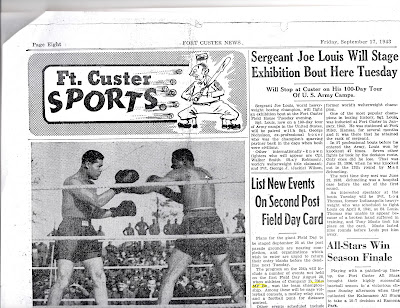
Source: Fort Custer News, Volume Three Number 33, page eight, 17 September 1943. Found at Fort Custer Historical Society Library, Battle Creek, Calhoun, Michigan

The last page of this edition was the Ft. Custer Sports page. The main article was about Sergeant Joe Louis staging an exhibition bout at Fort Custer. Other articles were about fishing, baseball standings, bowling season schedule, and a baseball tournament. 


You could even send the newspaper home. There was a blank address label to fill in, attach a 1 1/2 cent stamp and mail it.


These historic newspapers aren't hard to find. I googled "Fort Custer News" newspaper and the first hit was the Library of Congress. The page is part of the Directory of US Newspapers in American Libraries collection. A cursory look at the titles includes more than military newspapers, but it is worth a search for your ancestor's fort, camp, or regiment.


At the bottom of the newspaper page is an area "Libraries That Have It". The Fort Custer News is available at the Library of Michigan and the University of Michigan. More information on the dates and issues for the newspaper is included.


What military newspaper are you looking for? I would love to find the 1945-1946 editions of Fort McClellan, Alabama newspaper, The McClellan Cycle. My dad was stationed there after the War in Europe was over. He coached a regimental basketball team to victory over the other regiments there. I have pictures and blogged about it, but I would love to see if there is an article about the tournament. Scattered issues are available at Alabama Department of Archives and History Library, Montgomery, Alabama. A research trip needs to be added to my list. 


More than military information can be found in historic military newspapers from United States forts. Take a look, who knows what you will find about your ancestors.

Image credit: Pixaby


28 January 2022

Follow Friday: Kalamazoo Valley Genealogical Society

Do you belong to your local genealogical society? Joining a genealogical society in the area I live is a priority for me whether I have ancestors in the area or not. Kirk and I moved to Kalamazoo in October and once we were settled, I joined Kalamazoo Valley Genealogical Society (KVGS). 


Joining a society in the area you live has benefits to genealogists. One is the ability to network with people of similar interests. Another is the educational opportunities available furthers my genealogical knowledge and it helps me to know the history of the area where I live. 


I knew about the society from my role as President of Michigan Genealogical Council and Calhoun County Genealogical Society. Calhoun County is the county adjacent to Kalamazoo to the east. KVGS takes bus trips to Allen County Genealogy Center in Fort Wayne, Indiana. I went with them on one of their trips.


KVGS is holding their meetings virtually as many societies in Michigan are. They hold general meetings on the third Monday of the month. KVGS has skill sessions, special interest groups, and research trips. In addition, they have a wonderful website


One of the research trips that KVGS takes is to Washington, D.C. The group travels by bus to Washington D.C. The group researches at the National Archives, Library of Congress, DAR Library and more. On your own activities are available for non-researchers as well. This is one trip that my husband and I would like to take. This year's trip is scheduled October 23-29 pending the Covid situation.


KVGS was started in 1958 and has a long history in the Kalamazoo area. Kalamazoo Valley references the Kalamazoo River Valley throughout southwestern Michigan. Kalamazoo county is home to many libraries and museums. The Zhang Legacy Collections Center at Western Michigan University, in Kalamazoo, holds regional archives and special collections. Local history can be found at numerous libraries in the area.  


Do you have ancestors in Kalamazoo? If so, you need to join Kalamazoo Valley Genealogical Society.


27 January 2022

Three Keys to Using Michiganology


What is Michiganology?

Michiganology, the web platform for the Archives of Michigan, replaced Seeking Michigan. I found quite a learning curve to using Michiganology and I even attended presentations on it. I have been digging deeper into the website and thought I would share my tips on using it successfully.


What does Michiganology Mean?

-ology means the study of. Therefore, Michiganology is the study of Michigan. According to the Michiganology website their mission is to” foster curiosity, enjoyment, and inspiration rooted in Michigan’s stories.”

Michiganology is more than vital, census, or naturalization records. Those records were popular at Seeking Michigan. Seeking Michigan had about one million records. Now Michiganology visitors have access to over ten million records with room to grow.

How do I find records on Michiganology?

I heard this question over the years while I was President of the Michigan Genealogical Council. The process of creating a new website that can hold what is already digitized and have room for future growth was a huge undertaking. It was not without glitches, but I must give my congratulations to the staff of the Archives of Michigan. They have worked tirelessly to create this website.

Michiganology is more than Genealogical Records

The Archives of Michigan is not just for genealogists. This is important to remember. The Archives of Michigan is responsible for preserving state government records and other public institution records. While you will find death certificates, naturalization records, and state census records, you will also find state commissions records, the state Senate and House records, corporation records, and more.

The Archives of Michigan holdings include more than eighty million state and local government records and private papers, 300,000 photographs and 500,000 maps, plus films and audio tapes. Remember the Archives of Michigan works with more than genealogists.

The Archives of Michigan has two websites. One, Michiganology houses the online digitized records in their collection. The second one is the Michigan.gov/mhc website. The Archives of Michigan is part of the Michigan History Center. Michigan.gov deals with the business side of the Archives. Items such as hours, museums, events, and more can be found here. Eventually guides and circulars will be here.

Three Keys to Finding Items on Michiganology

1.                   Think about State Government. Michiganology does not have one area where you can go to find state records. There are many divisions of state government and each one is responsible for different record sets. Below are the divisions and what collection sets fall under their responsibility. I will explain why this is important next. Find each department at the bottom of the Collections page.

Michigan Department of

Administration-contains records from the Building Engineering Office.

Attorney General-records from the Attorney General’s Executive Office.

Community Health-records from the Mental Health Commission

Corrections-responsible for the state’s prisons

Education-records from the Library of Michigan

Environmental Quality-collection contains records from the Clean Air Assistance Compliance Advisory Panel

Health and Human Services-supports foster care and adoption, child support, abuse and neglect, vital records, safe sleep for infants, and aging and adult services.

Health-records from the Disease Control, Records, and Statistics Division

Insurance and Financial Services-records from the Consumer Services Division

Legislature-records from the House of Representatives and Senate.

Licensing and Regulatory Affairs-includes the Corporations Division and the Michigan Public Service Commission.

Management and Budget-collections includes Bureau of Facilities Management and Exposition and Fairgrounds Authority.

Military and Veterans Affairs- administers the state’s veterans’ affairs agency, veterans’ homes, and National Guard units.

Military Establishment- records from Office of the Adjutant General

Natural Resources-collection includes Archives of Michigan, Director’s Office, Marketing and Outreach Division, Michigan History Center, Parks and Recreation, Public Information Office, Real Estate Office, and Wildlife Division.

State Police-records from the Training Division.

State-Bureau of Elections, Bureau of History, Executive Office, and Office of the Great Seal.

Technology, Management and Budget-collection includes Center for Educational Performance and Information, Office of Financial Management, and Office of Retirement Services.

Transportation-records from the Complete Streets Advisory Council


2.                   Use State Government departments to find records.

Each department in number one sends records of importance to the Archives of Michigan. Some records are digitized and available at Michiganology. In the future records will be sent to the Archives of Michigan in a digital format. This will allow for faster upload times on the website. If you have records you are looking for, think about which department would be responsible for it. Here are a few examples.

a.       The Archives of Michigan is under the Department of Natural Resources. Go to the department page and click on Archives of Michigan.  There are three collections: Archival Collections on Microfilm, Archival Collection, and Audiovisual Materials. Each one of these has records from Seeking Michigan.

b.       If you are looking for the Military Regimental Records, 1861-1865, look under the Department of Military Establishment, Adjutant General records.

c.       If you are looking for Corporation Annual Reports, look under the Department of Licensing and Regulatory Affairs. Years 1997-2006 are available.

d.       Do you want to know what was in the State Constitution in 1835? Look under Department of State?

These are just four examples from the millions of records available online at the Archives of Michigan. 

Each collection page has a search within feature to help you locate the information.

3.                   Put Google to Work for You.

I know it is a copout to say this, but this time it will help. There is so much information on Michiganology it isn’t always easy to find. If I am having trouble finding information on Michiganology I google it. For example, I was looking for the civil war manuscripts that I knew had been digitized. I entered civil war manuscripts at Michiganology and found the link. Try your search using Archives of Michigan in place of Michiganology.

Archives of Michigan is working on streamlining indexes that will help with finding what you are looking for. It allows a deeper dive into the digital records. Remember, not everything is digitized and online.

The Archives of Michigan is working in partnership with Family Search to digitize and bring online the Michigan Naturalization records and the Probate Records. Both record sets will be online once they are digitized and transcribed.

Remarkable things are happening with the Archives of Michigan and Michiganology. Look using the above three keys at Michiganology. Happy Hunting!


26 January 2022

Christian Reformed Church Research, Calvin College, Grand Rapids, Michigan

Heritage Hall in the Hekman Library on the campus of Calvin College in Grand Rapids, Michigan is the place to go for Christian Reformed Church in North America records and Dutch Migration records.

The website is a treasure trove of information and may take a few minutes to acclimate yourself to it.  Heritage Hall is open to the public for onsite research, but you will want to plan your visit.  Their holdings are vast.

What will you find at Heritage Hall?

  1. The Archives of the Christian Reformed Church in North America. The archives online pages will guide you through a lot of information:
    1. Finding Aids
    2. Links to Information about the Christian Reformed Church (CRC)
    3. Banner , a publication of the CRC, card file index for deaths, birthdays, and wedding anniversaries published from 1870-1999.
    4. Membership records from six closed CRC churches. Scroll down to "Digital membership records from closed churches"
    5. Young Calvinist obituaries from 1941-1973. Scroll down to the end of the page.
    6. Emigrants from the Netherlands to North America, 1946-1963, mostly to Canada.
    7. Emigrants from Drenthe, Netherlands to West Michigan, 1845-1870.
    8. Wedding Databases Look at the In House Records for this.
    9. Dutch and German Immigrant Letters
    10. Family Histories
    11. Holland-America Line Passengers, 1900-1940. Microfiches copies of the lists with annual indexes, includes all passengers sailing on the Holland-America Line and is not limited to a single nationality

    12. Web based resources for Family History
    13. and more.
  2. Heritage Hall Finding Aids will guide you to resources available at the library.  A few simple searches led me to manuscript sources at Heritage Hall.
    1. Genealogy led me to 31 resources, many of them manuscript collections to explore further.
    2. Family History led me to 20 resources.
    3. Luijendijk, the dutch spelling, led me to 0 resources, but Luyendyk, the American spelling, led me 1 resource.
    4. Dutch in Michigan had 20 hits.
Even though it states the number of resources or hits, these are manuscript collections and can contain many boxes and linear feet of resources. 

     3.  Research Guides are available at the Hekman Library website. These guides help you to understand what is available at the Library. The library supports the language and culture of the Dutch and four research guides are available:
          a. Dutch Language
          b. Dutch Resources
          c. Dutch Articles and Databases
          d. Frisian Studies

If you have Christian Reformed research to conduct while you are in Grand Rapids, Calvin College is the place to do it. Use the Hekman Library Catalog to find resources at Heritage Hall.  The Archives of the Christian Reformed Church in North AmericaHekman LibraryHeritage Hall, Calvin College, 1855 Knollcrest Circle SE, Grand Rapids, MI 49546 (616) 526-7197. 

Information and weblinks updated on 26 January 2022

24 January 2022

Pure Michigan Genealogy-The End


Pure Michigan Genealogy

Michigan Resources Update: 24 January 2022 


As of today, the Pure Michigan Genealogy posts have been updated and broken links fixed. If new information is available since 2018, when I first started this series, I added it. Many websites that I had linked to changed. The biggest change was Seeking Michigan to Michiganology. If you are looking for a Seeking Michigan page, you will need to use the Wayback Machine at Internet Archive. Not all the information that was on Seeking Michigan has been transferred to Michiganology. Some of it will be found on the Archives of Michigan website. I plan a future blog post about how to use, and find items in, Michiganology and the Archives of Michigan websites.

Family Search website links had changed as well. If a link could not be found I deleted the information. I will continue to check for broken links. I will try to do a better job of timely updates.  Brenda

This is my ninth and final post on researching in Michigan, my home state. I tried to give you an overview of what is available when researching ancestors in Michigan.  The eight posts on Pure Michigan Genealogy is in no way a complete list of everything in Michigan.  That would take a book, and there is a good one-Michigan Genealogy, 2nd edition by Carol McGinnis.  I could never top what she has written.  If you think I could help you with your Michigan research, please email me or leave a comment.  I hope you have enjoyed my Pure Michigan Genealogy as much as I have enjoyed sharing it with you. 

I have a few general comments about researching Michigan ancestors.
  • Don't underestimate the importance of county level records and repositories. County government is central to Michigan genealogy research.  Vital records, land, property, probate, etc. are kept at the county level.  Many Michigan counties have genweb websites.  Check out the Kent County one, to see the variety of records one may find in their research by using Genweb.
  • Check the area you are researching for local genealogical societies, historical societies and libraries.  Put google to work for you!  Many genealogical societies have an online presence and accept queries for their newsletter, some have volunteers to look up information. Historical societies know what is available and where to find it for their locality or can guide you where to go next.  Many libraries have a local history section.  Check the library's online catalog, if available.  Tap into this valuable resource.
  • Don't forget about the value of social media. Libraries, Archives, Societies, and Cities have pages or groups on Facebook. Check the Genealogy on Facebook .pdf for thousands of Facebook links. Ask your questions in the area you are researching.
  • Come to Michigan.  Visit our state library and archives, all in one building. Roam our cemeteries, explore our courthouses, and check out our local libraries.  After a day of rewarding research, Michigan has even more to offer. Beautiful sunsets, sandy beaches, clear blue lakes, historic islands, rocky cliffs, and great people are yours to explore in Pure Michigan!   

My Michigan Genealogy Sources

I used a variety of sources for the nine Pure Michigan Genealogy posts.  A bibliography is listed here for your use.

DeBoer, Shirley, M, NGS Research in the States Series:  Michigan, Arlington, Virginia:  National Genealogical Society, 2008. Revised and updated 2018 by Brenda Leyndyke

Eichholz, Alice, Editor, Red Book, Provo, Utah:  Ancestry, 2004.

Family Search Wiki, "Research Outline:  Michigan", 

Holick, Jennifer, Legacy QuickGuide Michigan Genealogy, Surprise, Arizona:  Millenia Corportation, 2013.

McGinnis, Carol, Michigan Genealogy:  Sources and Resources, Baltimore, Maryland:  Genealogical Publishing Co., Inc., 2005.

"Michigan Land and Property", Family Search Research Wiki, 

"Scandinavian  Immigration", Harvard University Library, Immigration to the United States, 1789-1930.  

"Using Maps in Genealogy", United States GeographicalSurvey,
 https://pubs.usgs.gov/fs/2002/0099/report.pdf:  (accessed 1 March 2018).

VanderHill,  Warren C.  Settling the Great Lakes Frontier:  Immigration To Michigan, 1837-1924.  Lansing, Michigan:  Michigan Historical Commission, 1970. 

Pure Michigan Genealogy is a series of posts on researching in Michigan. The End concludes the series on Michigan Genealogy.  See below for the full list of posts.


Pure Michigan Genealogy: Living History


Pure Michigan Genealogy
Are you looking for information that goes beyond dates and facts?  You can "put the flesh on the bones" of your ancestors through social and living history information.  Michigan has wonderful historic places and sources that will help you understand what different times in Michigan History was like. 

  • Michigan Historical Museum-You can take an online gallery tour of exhibits on First People, Settling a State, Civil War, Farm and Factory, Lumbering, Mining, and Growing up in Michigan.  Each one of these categories takes you to a wealth of information on Michigan History.
  • Downward Bound-photographs and articles about the Great Lakes Shipping industry are featured here.
  • Great Lakes Lighthouse Keepers Association-did you know that Michigan has more lighthouses than any other state?  Michigan has over 100 lighthouses along it 3200 miles of shoreline.  This website has historical pictures, articles, and information on lighthouse keepers.
  • Museums-Michigan has many wonderful, historical museums from blacksmith shops, to railway, to civilian conservation corps, and mining museums.  Check out the hundreds of museums that Michigan offers by clicking on the museum name, if the museum has a website it will provide a link that will take you to that museum for photos and more information.
  • Detroit Historical Museum- a Detroit Historical Society museum has a variety of exhibits on display.  It is the premiere museum for the Detroit region history. 
  • Fort Mackinac-has the oldest building in Michigan on it.  It takes you back to the days when the British controlled the fort.
  • Colonial Michilimackinac-view pictures of this outpost pretty much as it was in the 1700's.
  • Henry Ford Museum-a wonderful museum filled with historical automobiles, from JFK's limousine, to Rosa Parks bus to the Weinermobile.  You will find more than cars here, though.  Check out the interactive map on its' website.  
  • Greenfield Village-on the grounds of the Henry Ford Museum.  Go back in time to seven historical villages depicting the life and times of Henry Ford, Thomas Edison and more. 
  • Michigan Heritage Park-in Northern Muskegon county, near Whitehall, takes the visitor through 10,000 years of Michigan history.
Many local museums and historical societies have living history areas in their smaller museums, be sure to check the area you are visiting for some of these gems.

You have your ancestor's birth, marriage and death information, now take a little time to put your ancestor in context to how they were living.  Living History can give you a picture of what it was like for your ancestors to go about their daily home and work life and have a little fun while doing it.

Pure Michigan Genealogy is a series of posts on researching in Michigan. Living History is number eight in the series.  Other posts in this series are below:


Pure Michigan Genealogy: Maps


Pure Michigan Genealogy
Maps are an important tool in your genealogy research.  Maps have a treasure trove of information ready for you to decipher.  Once you have accumulated a few facts, you will want to turn to maps to to truly understand your ancestors.  You will want to learn how they lived and where they lived.  You will want to look at old and new maps, online and paper maps.  Maps are a good resource because they will give you clues for where to look for more information.  If your grandparents owned a farm in Dickson Township, Manistee, Michigan, as mine did, you can look at the map and see what the nearest town was and where the county seat was located.  Maps can show towns, cemeteries, railroads, streets and roads, rivers and so much more.  There are many types of maps available for your Michigan research.

1.  Plat Maps are usually found on a county by county format.  They show land ownership at a certain place in a certain time.  They can be found in local county equalization offices, local libraries, or at local Michigan State University (MSU) Extension offices

2.  Topographic Maps offer an opportunity to locate farmsteads using selected cultural and physical features of the landscape.  Roads, fence lines, barns, orchards, gravel pits  cemeteries, railroad tracks and schools are cultural features.  Rivers, creeks, hills, valleys, lakes and swamps are physical features.      The United States Geological Survey (USGS) has articles on Using Maps in Genealogy.  The USGS website has topographical maps for Michigan and other states.

3.  Political Maps are the maps we usually use.  They show cities, towns, counties, etc. These are available at various places throughout Michigan.

4.  Fire Insurance maps will include businesses, schools, and churches.  Sanborn Fire Insurance maps are online at the Library of Congress.

One can find various Michigan maps online:

Pure Michigan Genealogy is a series of posts on researching in Michigan. Maps is number seven in the series.  Other posts in the series are below.